


Welcome to The Optionist. Thanks for reading along with me.
The book at the heart of this story isn’t a big seller, but the ethical questions here are worth pondering. It concerns Charity & Sylvia, a just-published graphic novel by Tillie Walden about the two women who basically lived together as an openly married couple in 1800s Vermont. Their relationship was the subject of Charity & Sylvia: A Same-Sex Marriage in Early America, a well-regarded book by historian Rachel Hope Cleves, which is the only book about a same-sex couple from before the Civil War ever published. Without Cleves’ hard work, no one would know this story.
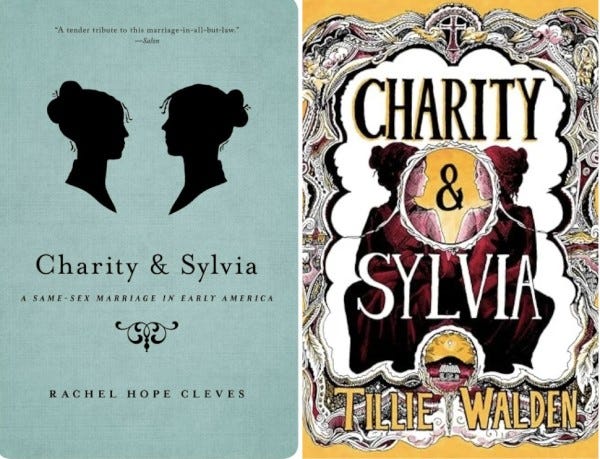
In retelling the story of the two women, Walden drew heavily on Cleves’ work — which she noted more than 50 times in online citations and also referenced in the acknowledgments. But is that enough? On social media, Cleves called it an adaptation “without credit or compensation.” And I tend to agree with her. Walden makes a big show of how much research she did and how many archives she visited, but as Cleves points out, all she did was minimally retrace Cleves’ steps, and she did not really contribute any new research.
The questions here are probably more ethical than legal. Walden didn’t plagiarize in the narrow sense of the word. Facts aren’t copyrightable, and archives are open to all. Still, Walden’s graphic novel so closely mirrors Cleves’ book that a case might be made — although the cost and time involved would likely be prohibitive.
But why do this at all? Isn’t it easier and more ethical to license the existing work for adaptation? As Cleves herself acknowledges, the illustrations and format make it a distinct experience from reading the book and open up the story to a new audience.
The bigger headline here is how we’ve devalued originality and the value of content. It started with the web, where “aggregation” just became a polite word for copying without acknowledgment, and continues to today, where AI takes without credit for “training.” Original and unique work, like Rachel Cleves’ book, should be celebrated, not plundered.

This beef between Children of Blood and Bone author, Tomi Adeyemi, and actress Amandla Stenberg is worth keeping an eye on over the next six months in the lead-up to the release of the film adaptation in January of the bestselling African-set fantasy series.
It started over the Fourth of July weekend when Adeyemi posted a TikTok in response to a question from a fan about why she hasn’t posted about the upcoming adaptation, which she co-wrote with the film’s director, Gina Prince-Bythewood.
Adeyemi responded by posting screenshots of a conversation with Stenberg where she told the actress, “Do not ever use my name in an interview or video again. Do not text me. Do not call me.” She added, “I have not seen the film and will not watch it. It’s been painful holding this back from you [the fans].” She then told the fans, “From this point on, if you want to support me, you can purchase any edition of the trilogy at a local independent children’s book store.”
Adeyemi didn’t elaborate on the roots of the dispute. Fans have speculated that it stems from the backlash over the casting of the light-skinned Stenberg to play a character described as dark-skinned in the book, and Stenberg’s response, in which she movingly said Adeyemi endorsed her casting. The texts Adeyemi shared were from February 2025, just after Stenberg’s casting was announced.
The debate about colorism and casting in the Black community is longstanding and fraught, but there are also the complicated dynamics of involving an author in an adaptation, how to keep them happy and what to do when they’re not.
The Children of Blood and Bone producers seemed to have wanted Adeyemi involved — not every author gets to write the screenplay — but something fractured the relationship in ways that appear unrepairable right now, leading to every producer’s worst nightmare: trying to promote the film adaptation of a book with a passionate fanbase with an author who is actively unhappy with the finished product.
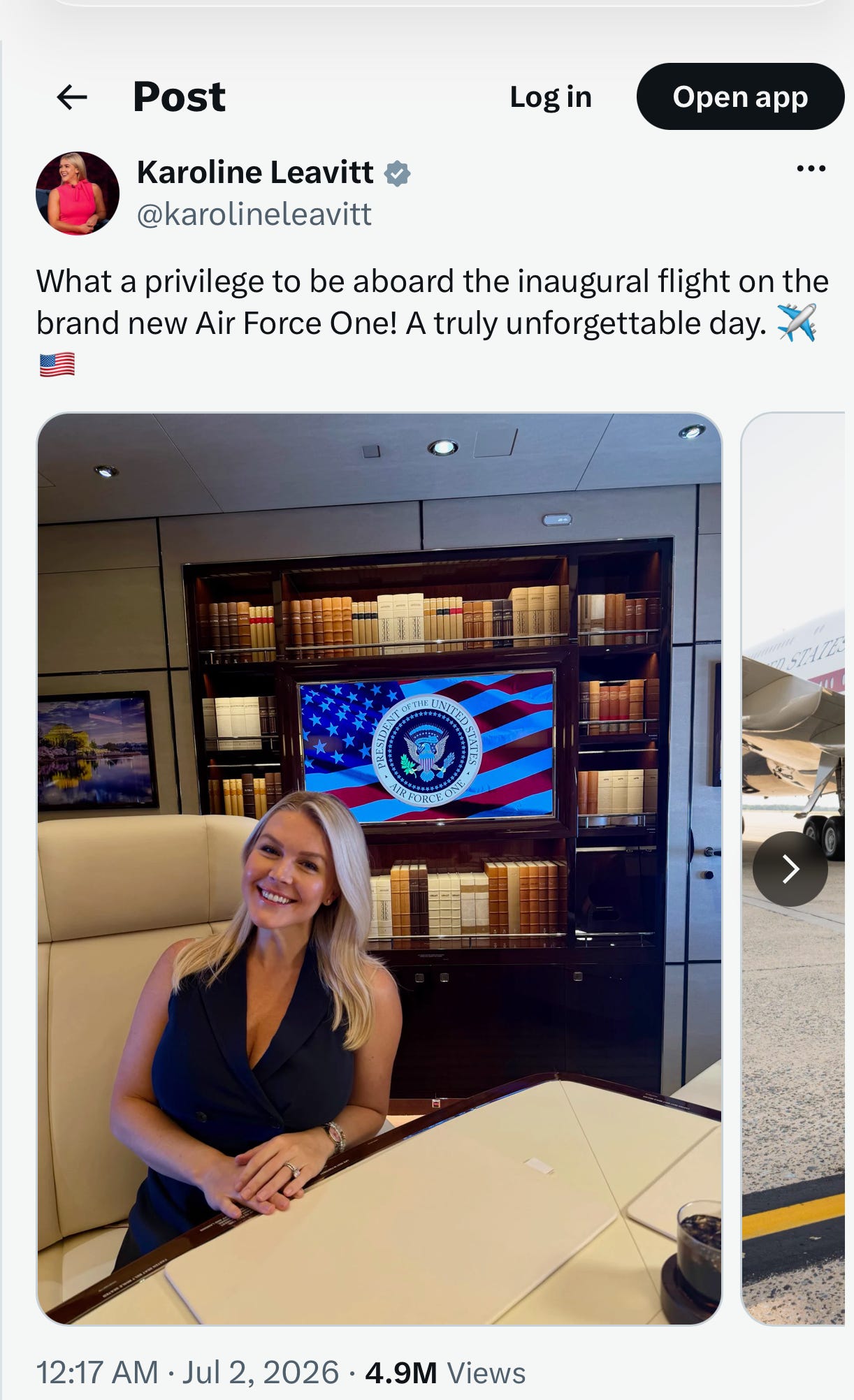
So Donald Trump has a new toy to play with: a 747, courtesy of the Qatari government, to be used as the new Air Force One. Trump was so eager to ride what he claims is a luxury upgrade to the older plane that he rushed it into service. He so rushed it into service, in fact, that the Secret Service wouldn’t let him fly it back from the NATO summit in Europe. But what caught my attention was this photo from Karoline Leavitt aboard the new plane, showing its library stuffed with what appear to be fake books. I can’t even.

This week: A Coen brothers-esque crime thriller, a satire about masculinity and bodybuilding and a detective with personality
There’s a great range in this week’s picks. I really liked the dark thriller with the Coen brothers’ sensibility. There’s something oddly satisfying sometimes in a story where no one wins in the end. The bodybuilding satire was completely different but no less enjoyable for me — I laughed out loud more than once at some of the antics in the book.
🔒The full lineup for paid subscribers:
⛟ A potential film with a Coen brothers tone about a truck heist gone awry.
🏋️♂️ A satire of masculinity and bodybuilding that’s movie-ready about a screwed-up former football player trying to win a local strongest man contest.
👮🏻♂️ A series-ready procedural centered on a detective trying to solve crimes while dealing with multiple personality disorder.
📚 A feel-good magical realist tale in the vein of Pushing Daisies and The Good Place, perfect for series development centered on a magic library that contains people’s memories.
